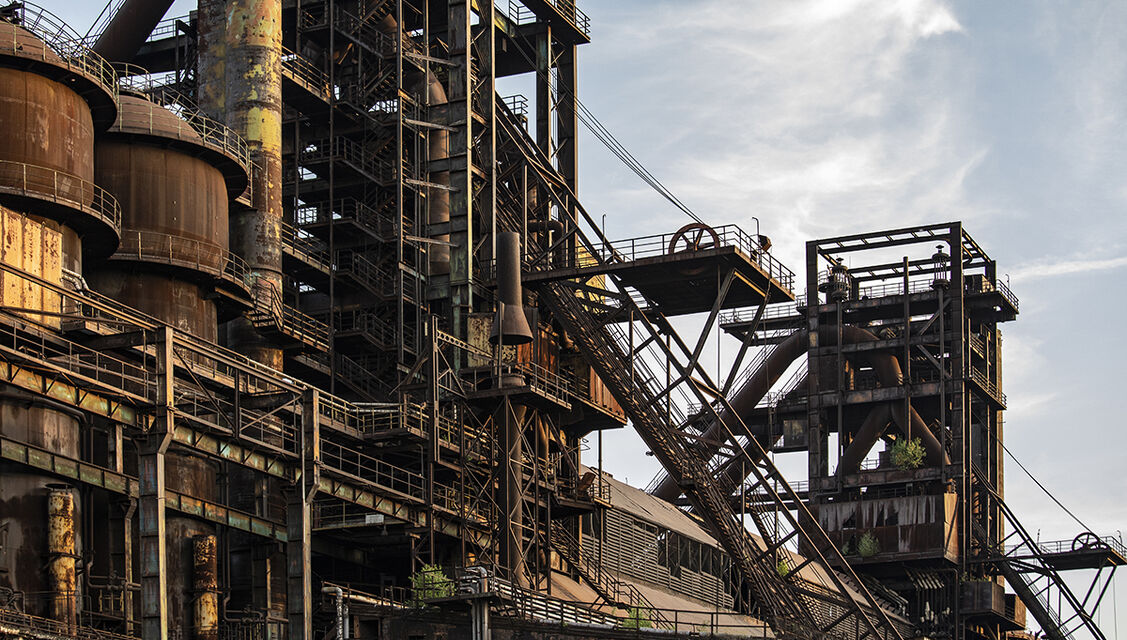
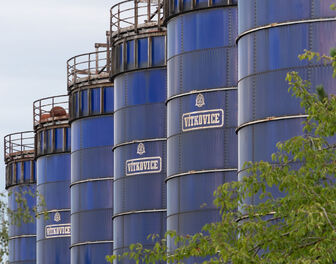
We are Blast Furnaces No. 4 and 6. For decades, we stood here with our flames burning day and night. But in September 1998, our fire finally went out. And with it came a big question: what would happen to us and to the entire Vítkovice complex?
This text is based on the “Talking Buildings” concept, which is part of the EU Horizon Europe project SINCERE. It allows buildings to speak in their own voice and offers a glimpse into their story through the eyes of the material that has witnessed history.
Ostrava had already lost many industrial landmarks. The Karolina coking plant and the Žofie ironworks had been demolished, leaving empty, unattractive gaps in the city. Promised new projects never came and many feared the same fate awaited us.
The First Spark: A Path Toward Heritage Protection
To our surprise, things took a different turn. In 1994, while we were still in operation, a process began to declare us with the whole complex a cultural monument. People suddenly started talking about our value, not only as machines, but as witnesses of history.
We heard stories about the Völklingen Ironworks in Germany, which had just become a UNESCO World Heritage Site. If another blast furnace could become a place for learning and discovery, maybe there was hope for us too.
At a time when technical monuments were usually reduced to a few fragments, but our greatest value was exactly in our completeness. We were still standing together, tall, rusty, silent, but whole.
To Save Us or Tear Us Down?
In 2000, the area was officially declared a cultural monument. But the debates didn’t stop. Some wanted to keep us, restore us or give us a new purpose. Others thought the city should move on and leave heavy industry behind, even if it meant our demolition.
Many ideas floated around. Turning the area into a “managed ruin,” keeping only the most iconic structures, building a museum, an industrial open-air park, a concert hall. Some imagined light industry returning around our foundations.
But everything came up against the same problem: money. Our owner, Vítkovice company, was going through a serious financial crisis. Even though they didn’t want to lose us, they simply couldn’t afford to save us. A non-profit organization was suggested, but the task was too large and the voices too weak.
We Could Hear the City Speak
While these discussions echoed around us, Ostrava was changing. Coal mining was ending, factories were struggling, and many people wanted to forget the industrial past. Around us, shops closed, services declined, and neighborhoods slowly emptied.
And yet, when Ostrava residents were asked, their voices surprised everyone – keeping us. 80 % of people said they wanted us to stay. They didn’t see us as a burden, but as a part of who they were. Their support became a spark of strength in a difficult time.
The Turning Point
A turning point came in 2007, when the Dolní oblast VÍTKOVICE Association was founded. We watched as architect Josef Pleskot was invited to reshape the urban concept and transform many of the industrial buildings around me. Little by little, the area began to gain a new face. Blast Furnace No. 1 rose again as the Bolt Tower, the gas holder became the multifunctional Gong auditorium, and architect Zdeněk Fránek turned the former power station into a technical museum. Life returned to Vítkovice, and by 2016 I saw 1.3 million visitors stream through the site each year.
A New Chapter Begins
For a long time, we – Blast Furnace No. 4 and No. 6 – stood untouched by these changes, even though several projects for our transformation had already existed. We finally felt new attention turn toward us in 2021 with the establishment of MUSEum+. Two years later, Josef Pleskot’s studio prepared a proposal for our transformation, and this year, 27 years after we went dark, work on our new design has begun.
Come and follow us on the journey we are about to start. More stories will follow, each revealing another layer of our memory and transformation.
Photo credit: Ondřej Durczak
This text is based on the “Talking Buildings” concept (https://talkingbuildings.net/en), carried out as part of the SINCERE project – The second life of modern period architecture: Resilient and adaptive renovation towards net-zero carbon heritage buildings (https://sincere-project.eu/), funded by the European Union’s Horizon Europe programme.